
ContentFit Guide
How to Get More Views on YouTube Without Guessing What to Make Next
More uploads do not automatically create more views. A stronger process starts with choosing topics people care about, checking what has worked on your channel, and deciding which opportunities fit your audience.
Updated August 2, 2026 · Approximately 10-minute read
Direct answer
How do you get more views on YouTube?
To get more views on YouTube, start by choosing topics with real audience interest, package each video around one clear promise, and use your channel history to identify subjects and formats that repeatedly perform well. Then improve the title, thumbnail, opening, and delivery. No single tactic guarantees views, but stronger topic decisions give each video a better opportunity to earn attention.
Why getting more views starts before you publish
Many creators try to improve views after the main decision has already been made.
They adjust the title, redesign the thumbnail, add keywords, share the link, or publish more often. Those actions may help, but they cannot fully rescue a video built around a topic that few people want or that does not fit the channel’s audience.
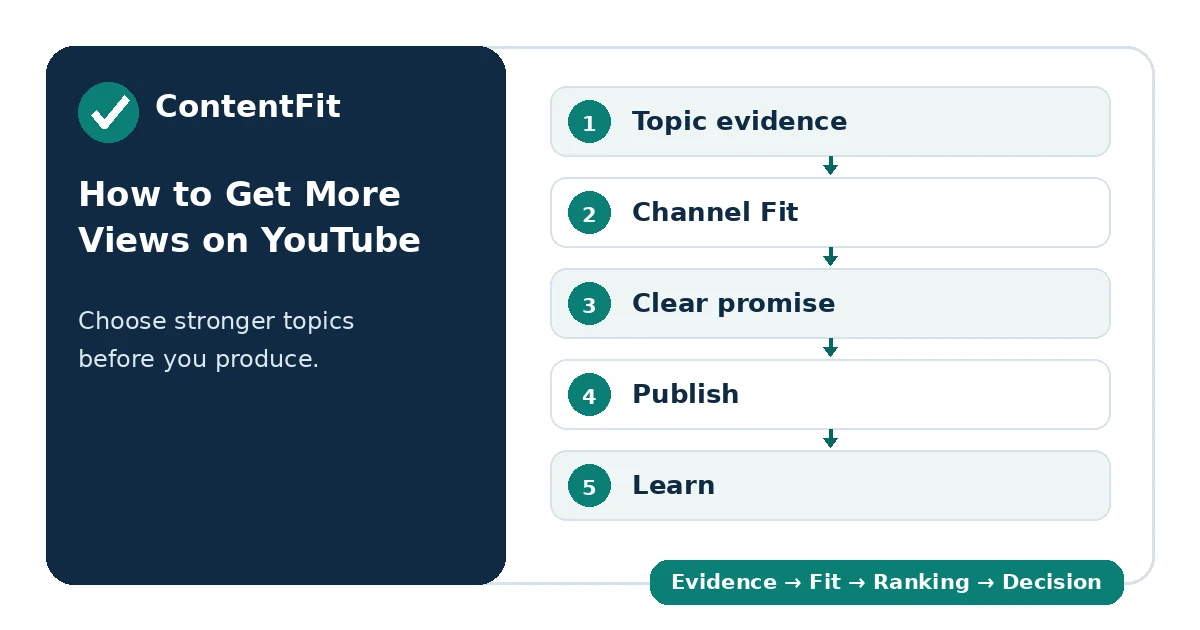
A better process starts earlier:
- Find a topic with evidence of audience interest.
- Check whether that topic fits your channel.
- Turn the topic into one clear video promise.
- Package the promise with a title and thumbnail.
- Deliver the value the title and thumbnail promised.
- Use the results to improve the next decision.
YouTube describes content performance through three broad questions: Did viewers choose the video, did they continue watching, and were they satisfied? YouTube also states that topic interest, competition, and seasonality can affect how many people see a video.
That means getting more views is not one trick. It is a chain of connected decisions.
1. Choose a topic people already care about
A well-produced video can still struggle when the topic has weak demand.
Before spending hours scripting, recording, and editing, ask:
- Does this solve a recognizable problem?
- Is the audience already discussing or searching for it?
- Are similar videos currently earning meaningful attention?
- Is the subject timely, evergreen, or seasonal?
- Does the audience understand the value immediately?
- Is there a clear reason to watch this video now?
YouTube notes that some topics have larger audiences than others and that interest can change because of trends and seasonality. A strong video in a narrow subject may still receive fewer impressions than a relevant video in a broader area of interest.
This does not mean you should chase every popular topic. It means you should understand the size and timing of the opportunity before committing production time.
Practical topic-research sources
Use several signals together:
- YouTube search suggestions
- Google Trends
- Relevant competitor and adjacent channels
- Questions in comments and communities
- Recent videos that performed unusually well
- Your own channel’s top-performing topics
- Recurring problems your audience asks about
- Timely changes in your niche
YouTube search predictions are influenced by popularity, similarity, and what people are searching for. They can reveal useful language, but they are only one signal and should not be treated as proof that a topic will perform.
2. Compare each idea with your channel history
Your channel history contains evidence about what your audience has already chosen to watch.
Review a reasonable sample of comparable videos and look for:
- Topics that repeatedly earn above-typical views
- Formats that perform better than your usual baseline
- Recurring audience problems
- Title patterns that produce interest
- Subjects that attract returning viewers
- Videos that continue receiving views over time
- Topics that produced one unusually strong outlier
Do not compare every video equally.
A two-minute update, a 40-minute interview, and a tutorial published two years ago may not be meaningful comparisons. Compare videos with similar formats, audiences, and stages of maturity where possible.
The goal is not to prove exactly why a video performed. Public data rarely provides that certainty.
The goal is to find patterns worth investigating.
3. Look for outlier videos
An outlier is a video that performs substantially above a useful comparison baseline.
For example, if a channel’s comparable videos usually receive about 10,000 views and one receives 30,000, that video may deserve closer review.
Ask:
- What topic did it cover?
- What problem or outcome did the title communicate?
- How was the subject framed?
- Did the thumbnail reinforce the same promise?
- Was the topic timely?
- Was the format different?
- Did similar topics perform well more than once?
- Is the result likely to transfer to your channel?
Use this reasoning structure
Observed evidence → Possible interpretation → Proposed test
Observed evidence: A video received three times the channel’s typical views.
Possible interpretation: The narrow, outcome-focused promise may have made the value easier to understand.
Proposed test: Use the same promise structure with a different subject relevant to your own audience.
Do not write: “This title caused the video to succeed.” Public views alone cannot prove causation.
4. Study competitors without copying them
Competitor research should help you understand audience demand, not reproduce another creator’s work.
Look for:
- Recurring topics across several channels
- Videos that outperform each channel’s normal range
- Titles that express a clear problem or transformation
- Topics receiving renewed attention
- Gaps that established channels have not answered well
- Audience questions left unresolved in comments
- Formats that may suit your expertise
Then ask what would make the idea useful on your channel.
A topic that works for a large entertainment channel may not transfer to a business educator. A video that succeeds because of celebrity access, breaking news, unique authority, or a large existing audience may not be repeatable.
Study the mechanism, not just the surface topic.
5. Check Channel Fit before committing
A popular idea is not automatically the right idea for your channel.
Channel Fit asks whether the opportunity matches your audience, subject history, expertise, content format, production capacity, channel promise, and business or creator goal.
Audience fit
Would your existing viewers reasonably care about this subject?
Topic fit
Does the idea connect to themes your channel already covers?
Authority fit
Can you provide credible experience, evidence, or perspective?
Format fit
Can the topic work within the type of videos your audience expects?
Production fit
Can you execute the idea well with the available time and resources?
Goal fit
Does the video support audience growth, revenue, leads, authority, products, services, or another meaningful goal?
An idea can have strong external demand and still be a poor fit.
ContentFit treats outlier evidence and Channel Fit as separate decisions for that reason. See how ContentFit evaluates public evidence and Channel Fit.
6. Rank your next video opportunities
Do not leave the research process with 40 unranked ideas.
Rank the strongest candidates using five factors:
- Evidence strength: Is there meaningful public or channel evidence?
- Audience relevance: Does the topic solve a problem the audience cares about?
- Channel Fit: Does it match the channel’s history, expertise, and format?
- Packaging potential: Can the value be expressed through a clear title and thumbnail?
- Production feasibility: Can the video be produced well with available time and resources?
Create a shortlist of no more than three opportunities.
You may have fewer than three when the evidence is weak.
A short ranked list creates a stopping point. It helps you move from research to production without adding weak ideas simply to fill a schedule.
7. Build one clear promise
Once you choose the topic, define the main promise.
Complete this sentence:
After watching this video, the viewer will understand, avoid, choose, fix, create, or achieve ______.
A strong video promise is usually specific, easy to understand, relevant to a real problem, possible to communicate visually, and supported by the actual video.
Weak promise: Some thoughts about growing on YouTube
Stronger promise: How to choose your next YouTube topic using evidence from your channel
The title, thumbnail, and opening should support the same promise.
8. Improve the title and thumbnail together
Titles and thumbnails should not communicate two different ideas.
The title can provide context, specificity, or curiosity. The thumbnail can make the central outcome or conflict visible.
Together, they should help a potential viewer understand what the video is about, why it matters, what they may gain, and why this version deserves attention.
YouTube describes impressions as the number of times a thumbnail is shown on eligible YouTube surfaces. Impressions click-through rate measures how often someone watches after seeing the thumbnail. YouTube recommends reviewing impressions and click-through rate together and in context because performance varies by traffic source and audience.
Do not optimize only for clicks.
A title and thumbnail that create the wrong expectation may earn initial clicks but lose viewers when the video fails to deliver the promised value.
9. Deliver the promise quickly
The opening should reassure viewers that they chose the right video.
Avoid:
- Long logo animations
- Unrelated personal updates
- Repeating the title for a full minute
- Delaying the answer unnecessarily
- Asking for subscriptions before establishing value
Instead:
- Restate the problem.
- Clarify the result the viewer will receive.
- Show why the answer is credible.
- Begin delivering value.
YouTube’s audience-retention reporting can show where viewers continue watching, rewatch, skip, or leave. The introductory retention measure indicates what percentage of viewers are still watching after the first 30 seconds.
Use that evidence to improve future openings.
10. Use YouTube Analytics to improve the next decision
Analytics should not only tell you what happened. Use them to improve what you make next.
- Views compared with your normal baseline
- Did the video perform above, near, or below your typical comparable videos?
- Impressions
- Did YouTube show the video to a meaningful number of viewers?
- Click-through rate
- Did viewers choose the video after seeing the title and thumbnail?
- Audience retention
- Did the video hold attention and deliver the promised value?
- Traffic sources
- Did viewers find the video through search, browse, suggested videos, external sources, or another path?
- New and returning viewers
- Did the topic reach new people, serve existing viewers, or do both?
- Comments and audience questions
- What problems, objections, or follow-up topics appeared?
YouTube Studio provides channel- and video-level reports covering reach, engagement, audience, impressions, views, click-through rate, watch time, retention, and viewer groups.
Do not judge every video by one metric. Use several signals to understand the full result.
11. What does not guarantee more YouTube views?
None of these actions guarantees more views:
- Posting every day
- Adding more tags
- Copying a viral title
- Using an AI idea generator
- Changing a thumbnail repeatedly without a reason
- Chasing every trend
- Making every video longer
- Buying views
- Copying a competitor exactly
- Using a supposedly perfect upload time
YouTube states that there is no universal ideal video length and recommends using the length needed to deliver value without filler. YouTube also says tags are mainly useful for common spelling variations and are not essential for discovery.
Choose a strong opportunity → Check Channel Fit → Package it clearly → Deliver the promise → Learn from the result
A repeatable process is more valuable than a supposed growth hack.
Frequently asked questions about getting more views on YouTube
How can I increase my YouTube views?
Start by choosing topics your audience cares about, then communicate one clear promise through the title and thumbnail. Use YouTube Analytics to compare results, identify repeatable topics, and improve your next video. Publishing more often cannot compensate for consistently weak topic choices.
Can I get more YouTube views without subscribers?
Yes. YouTube can surface videos through search, the homepage, suggested videos, and other recommendation areas. Subscribers can help create an initial audience, but videos can also reach people who have never seen the channel before. The topic, packaging, viewer response, competition, and audience interest all matter.
YouTube states that recommendations appear across several surfaces and are personalized using viewing behavior and satisfaction-related signals.
Do hashtags help YouTube videos get more views?
Hashtags may help provide context or connect a video with a subject, but they are not a substitute for a strong topic, title, thumbnail, and useful video. Focus first on whether the audience wants the topic and whether the video delivers the promised value.
Does posting more often increase YouTube views?
Posting more often creates more chances to publish a successful video, but frequency alone does not guarantee views. Choose a schedule that allows you to maintain useful topics, clear packaging, and strong delivery without adding filler.
What YouTube Analytics should I check?
Start with views compared with your normal baseline, impressions, click-through rate, audience retention, watch time, traffic sources, and new versus returning viewers. Use these metrics together rather than treating one number as the complete explanation.
Why are my YouTube videos not getting views?
Possible reasons include low topic interest, strong competition, unclear titles or thumbnails, poor audience fit, weak viewer response, seasonality, or limited channel history. Review several comparable videos before assuming one metric or one algorithm change caused the problem.
What is the fastest way to get more YouTube views?
There is no reliable shortcut. The fastest useful improvement is often choosing a stronger topic and expressing its value more clearly before production. Avoid buying views, copying viral videos blindly, or relying on tactics that do not build a real audience.
How long does it take to get more views on YouTube?
There is no fixed timeline. Some videos receive most of their attention quickly, while search-based and evergreen videos may build views over time. Judge performance against comparable videos on your own channel rather than using one universal deadline.
Sources and further reading
This guide uses official YouTube documentation for factual platform statements. ContentFit’s analysis and recommendations are directional interpretations, not guarantees.
- How YouTube recommendations work
- Understand external factors: topic interest, competition, and seasonality
- Understand content performance and recommendation signals
- Understand impressions and click-through rate
- Get started with YouTube Analytics
- Understand engagement and audience retention
- Understand your YouTube audience
CONTENTFIT EARLY ACCESS
Interested in what ContentFit is building?
ContentFit is validating evidence-backed tools for media businesses that want better commercial visibility, asset monitoring, and less repetitive manual work.